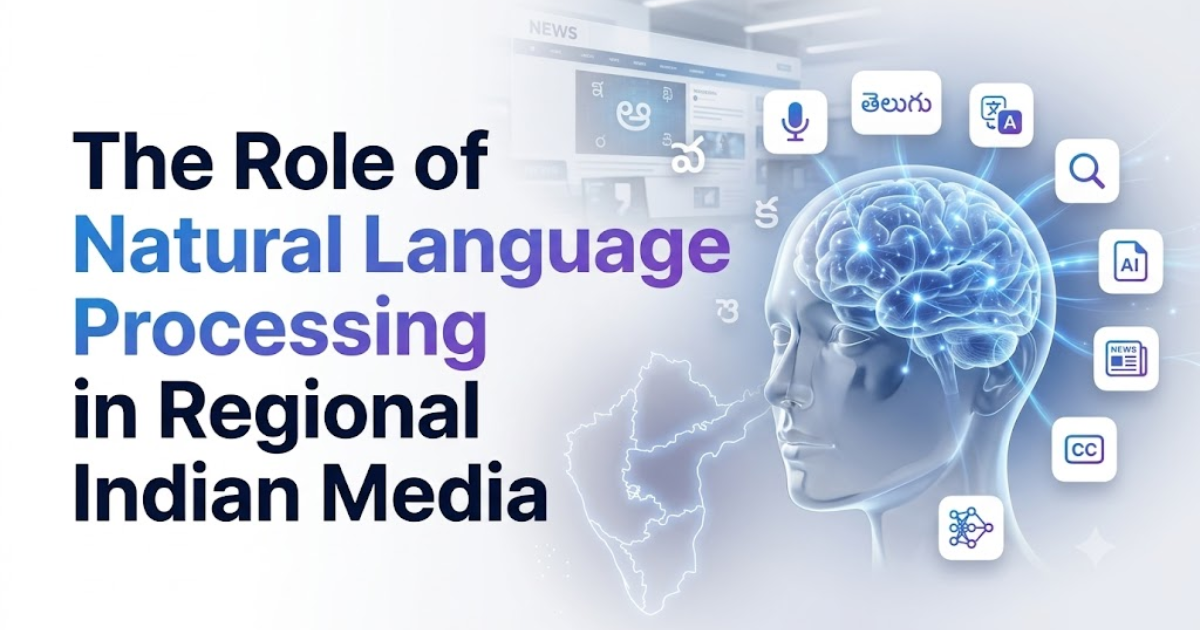
Regional language journalism is undergoing a major digital transformation, and natural language processing (NLP) is playing a central role in that change. As millions of Indians consume news in languages such as Telugu, Tamil, Hindi, Bengali, Kannada, and Marathi, publishers are increasingly exploring AI-powered language technologies to improve content creation, discovery, and user experience.
For Telugu media in particular, NLP has the potential to make digital publishing faster, more accessible, and more relevant for readers across Andhra Pradesh, Telangana, and Telugu-speaking communities worldwide.
What Is Natural Language Processing?
Natural Language Processing (NLP) is a branch of artificial intelligence that enables computers to understand, interpret, generate, and analyze human language. Instead of simply matching keywords, modern NLP systems recognize context, meaning, grammar, and relationships between words.
For regional Indian languages, NLP helps bridge the gap between human communication and digital technology, making online information easier to create, organize, and access.
Speech-to-Text for Faster Content Creation
Speech-to-text technology automatically converts spoken language into written text.
For Telugu publishers, this can simplify tasks such as:
- Transcribing interviews
- Converting press conferences into articles
- Creating news drafts from reporter recordings
- Producing captions for videos
As speech recognition continues to improve, journalists may spend less time manually typing transcripts and more time focusing on reporting and verification.
Translation Expands Audience Reach
Translation powered by NLP allows publishers to make content available in multiple languages.
A Telugu news article could be translated into English, Hindi, or other Indian languages to reach broader audiences. Likewise, important national stories published in English can be translated into Telugu more efficiently.
Although machine translation has improved significantly, human editors remain essential for preserving cultural context, tone, and linguistic accuracy.
Entity Recognition Improves News Organization
Named Entity Recognition (NER) is an NLP technique that identifies important names and references within text.
It can recognize:
- People
- Places
- Organizations
- Government departments
- Political parties
- Events
- Dates
For Telugu news publishers, entity recognition can automatically tag articles, improve internal linking, and organize large collections of content for easier navigation.
Smarter Search Experiences
Traditional website search depends heavily on exact keyword matches. NLP-powered search goes further by understanding user intent and natural language.
For example, a reader searching:
“What are today’s Telangana government announcements?”
may receive relevant results even if the article headline uses different wording.
This creates a more intuitive search experience for Telugu readers using both text and voice search.
Automatic Content Categorization
Large news websites publish hundreds of stories every day.
NLP systems can automatically classify articles into categories such as:
- Politics
- Business
- Sports
- Entertainment
- Technology
- Education
- Health
Automated categorization helps publishers organize content consistently while reducing manual effort.
Personalized Recommendation Systems
Recommendation engines analyze reader interests to suggest related content.
For Telugu audiences, recommendation systems may highlight articles based on:
- Reading history
- Preferred topics
- Geographic location
- Trending stories
- Recently viewed content
Better recommendations can increase engagement while helping readers discover stories they may have otherwise missed.
Understanding Public Opinion with Sentiment Analysis
Sentiment analysis examines the emotional tone of written content or public responses.
Publishers may use it to analyze:
- Reader comments
- Social media discussions
- Public reactions to major events
- Audience feedback
Rather than replacing editorial judgment, sentiment analysis provides additional insights into how stories are being received.
Automated Subtitles Improve Accessibility
Video continues to dominate digital media.
NLP combined with speech recognition can automatically generate subtitles for:
- News videos
- Interviews
- Live streams
- Educational content
Accurate subtitles improve accessibility for hearing-impaired audiences while making videos easier to watch in different environments.
Archive Discovery Becomes Easier
Many regional publishers have decades of archived content.
NLP can help readers quickly discover historical articles by understanding concepts rather than relying only on exact keywords.
For example, a search about agricultural policy could surface older reports discussing the same issue using different terminology.
This makes valuable journalism more accessible over time.
Supporting Fact-Checking Workflows
NLP can assist editorial teams by identifying claims, extracting key information, and locating related articles or public records more efficiently.
It can also help compare multiple reports covering the same topic, making it easier for journalists to review supporting information during the fact-checking process.
However, editorial verification remains essential, as AI tools should support—not replace—human judgment.
Challenges for Telugu NLP
Despite rapid progress, several challenges remain for Telugu language processing.
These include:
- Regional dialect variations
- Mixed Telugu-English conversations
- Limited high-quality language datasets
- Complex grammar and sentence structures
- Differences between formal and conversational Telugu
- Ambiguous words with multiple meanings
Researchers continue to improve Telugu NLP models through larger datasets, better language modeling, and advances in machine learning.
NLP and Regional Digital Publishing
As regional digital media continues to grow, NLP can support many publishing workflows, including content organization, multilingual discovery, search optimization, subtitle generation, and audience engagement. These technologies have the potential to help publishers deliver information more efficiently while maintaining editorial quality.
Within the Telugu digital media landscape, platforms such as Udayam Digital illustrate the growing importance of regional online publishing. As NLP technologies continue to mature, publishers across the industry may benefit from adopting AI-assisted workflows where appropriate while continuing to rely on journalists and editors for accuracy, context, and editorial oversight.
The Future of NLP in Indian Regional Media
Natural language processing is expected to become increasingly important as regional language audiences continue to expand online.
Future developments may include:
- More accurate Telugu speech recognition
- Improved multilingual translation
- Better voice search experiences
- Smarter news recommendations
- Enhanced accessibility features
- More efficient newsroom workflows
- Faster archive retrieval
- Improved AI-assisted content management
As language technology advances, regional publishers will be better equipped to serve readers in their preferred language.
Conclusion
Natural Language Processing is reshaping how regional Indian media creates, organizes, and delivers digital content. From speech-to-text and translation to search, recommendations, subtitles, and fact-checking support, NLP offers practical tools that can improve both newsroom efficiency and audience experience.
For Telugu publishers, these technologies present significant opportunities to expand accessibility, enhance discoverability, and better serve growing digital audiences. While AI can automate many language-related tasks, skilled journalists and editors remain essential for ensuring accuracy, context, and trustworthy reporting.